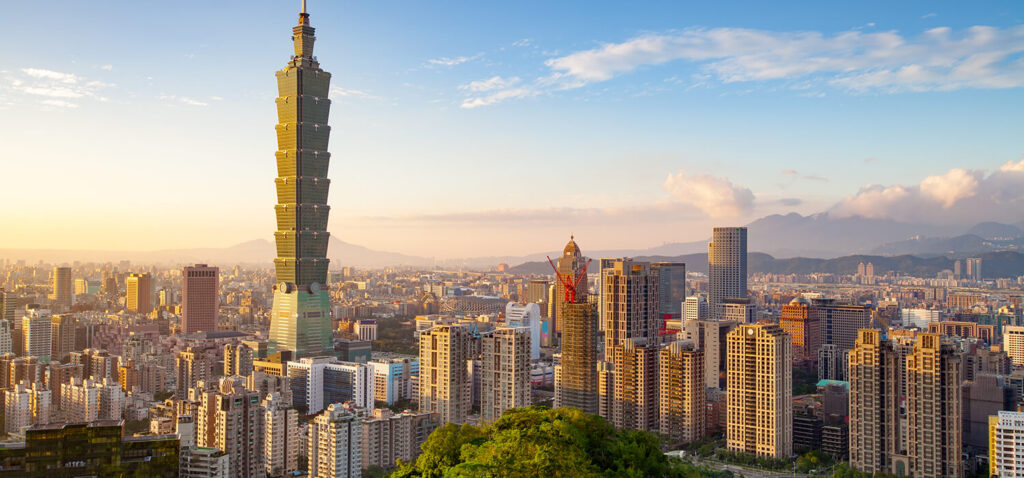
Taipei
Regional Overview
With a population of nearly 7 million people, the Taipei metropolitan area includes both Taipei City and New Taipei City (formerly Taipei County). Urban centers on the island of 13,974 mi² (most comparable to the state of Maryland) are densely populated, with Taipei being its political, economic, and cultural hub. Homegrown tech companies such as ASUS, HTC, and D-Link were founded in the Taipei area, with many others such as Acer and Foxconn headquartered in the region. Civic organizations and activists played a critical role during Taiwan’s democratic transition in the 1980s and 90s, building on the mobilization efforts of the labor, environmental, student, and women’s movements. Today, civic life in Taipei is vibrant, with large foundations and small community organizations alike working in issue advocacy, professional development, welfare service, education, and cultural preservation.
Taipei is a global city that has intentionally preserved much of its local traditions and community characteristics through both governmental and civic efforts. This commitment is deeply reflected in its nonprofit sector. A key feature of the sector is the strong presence of smaller-scale community-based religious, cultural, leisure, and arts organizations. Community life is active and observable in public spaces across the city. Larger nonprofit organizations or foundations often have ties to political parties, and maintain good relationships with politicians. Recent increased immigration from Southeast Asian countries has also broadened the scope of nonprofit work and service populations.
Our research takes an in-depth look across diverse civic organizations in Taipei. We hope to assess how Taiwan’s fairly recent democratic transition may have contributed to the dual trajectories of the sector’s development–smaller-scale organizations working on preserving traditional features of Taipei and larger ones promoting democratic governance and embracing global nonprofit trends. At the same time, they occupy a small and dense geographical space, frequently having to share urban spaces and work together. Finally, we’re interested in learning how the country’s diplomatic challenges at the global level may impact the way nonprofit actors function and respond (and how they interpret these challenges), as they often times are given international recognition over government actors.
The interactive map below displays the distribution of a randomly selected group of nonprofits in Taipei. Participants in the the study will gain access to a password protected site to explore the various characteristics (size, age, issue area) of themselves in comparison to their nonprofit peers.
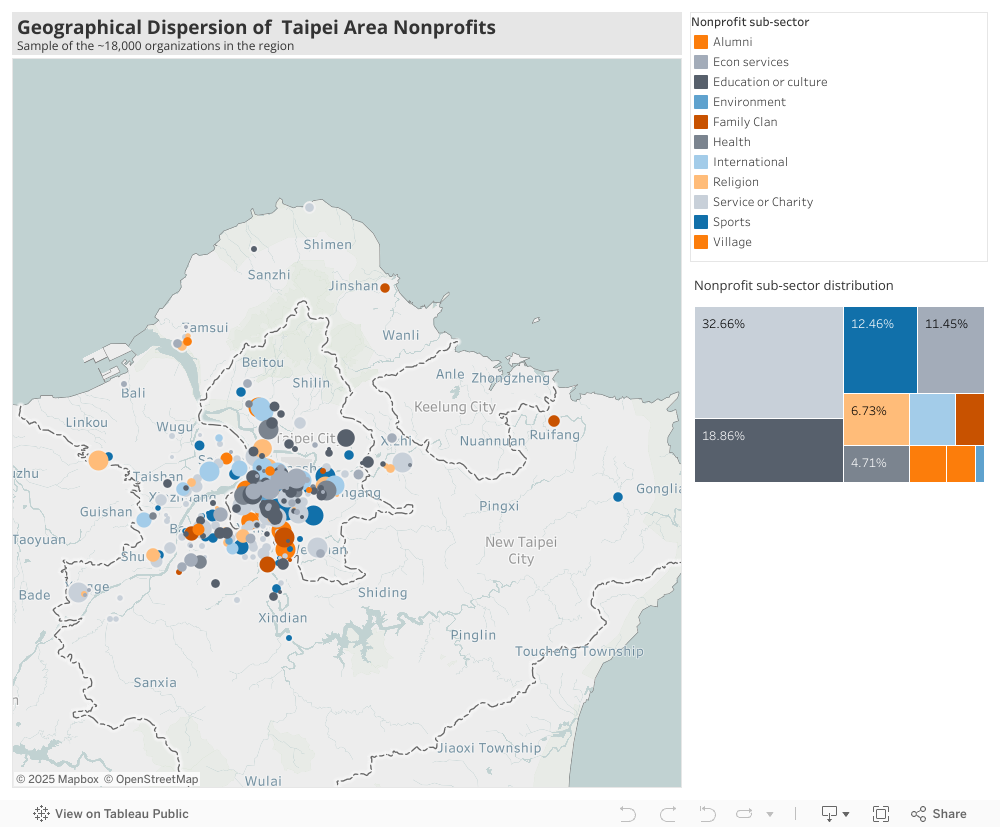
Click on the map to view the interactive dataset in a new tab.
People
- Total residents: 6.7 million (2.7 million in Taipei City, 4 million in New Taipei City)
- Race: 97% Han Taiwanese (including 15% Hakka), 2% Foreign, 1% Indigenous Taiwanese
- Median household income: ~$907,000-1.2 million NT ($27,913-38,254 USD)
- Poverty rate: 1.5% (Monthly income per person of less than $468-529 USD, savings and investments of less than $2,391-4,782 USD, and property of less than $115,400-235,900 USD)
Nonprofit Sector
- Total nonprofit organizations: 18,000 (shehui tuanti)
- People to nonprofit ratio: 372 people: 1 nonprofit organization
Place
- Area: 898 sq. miles (2,325 sq. km) [Taipei City: 105 sq. miles (272 sq. km), New Taipei City: 793 sq. miles (2,052 sq. km)
- Population density: 7,461 inhabitants/sq. mile (2,882 inhabitants/sq. km) [Taipei City: 25,714/sq. mi (9,782/sq. km), New Taipei City: 2,051/sq. mi (1,950/sq. km)
- Founded: 1875
All indicators are as of 2019.