
Vienna
Regional Overview
With its 2.5 million inhabitants, the Vienna region is the biggest urban center in Austria, and also the second largest German speaking city (second only to Berlin). Vienna serves as a hub for the wider Central European region that stretches beyond national borders, including Slovakia, Hungary, Slovenia, and the southern parts of the Czech Republic. Vienna still draws on its history as an imperial capital, working as a central place for the intellectual, civic, and business life of middle Europe. Civil society organizations (CSOs) play an important role in social and economic life of the Vienna region. A vibrant, heterogeneous sector of more than 20,000 CSOs provides society with welfare services, engages in advocacy activities, and serves as a crucial vehicle for community building.
A key feature of the sector is its close relationship with the state and political parties, a political arrangement defined by scholars as corporatism. CSOs receive a large share of their income from public sources, notably providing social services in return. The nonprofit sector is composed of a few large and established organizations with close links to political parties that are also highly relevant in economic terms, and of a large number of small associations, which are particularly important for the social life in the communities. Recent developments include a decrease in public funding and support for civil society, alongside a rise in social entrepreneurship.
The interactive map below displays the distribution of a randomly selected group of nonprofits in Vienna. Participants in the the study will gain access to a password protected site to explore the various characteristics (size, age, issue area) of themselves in comparison to their nonprofit peers.
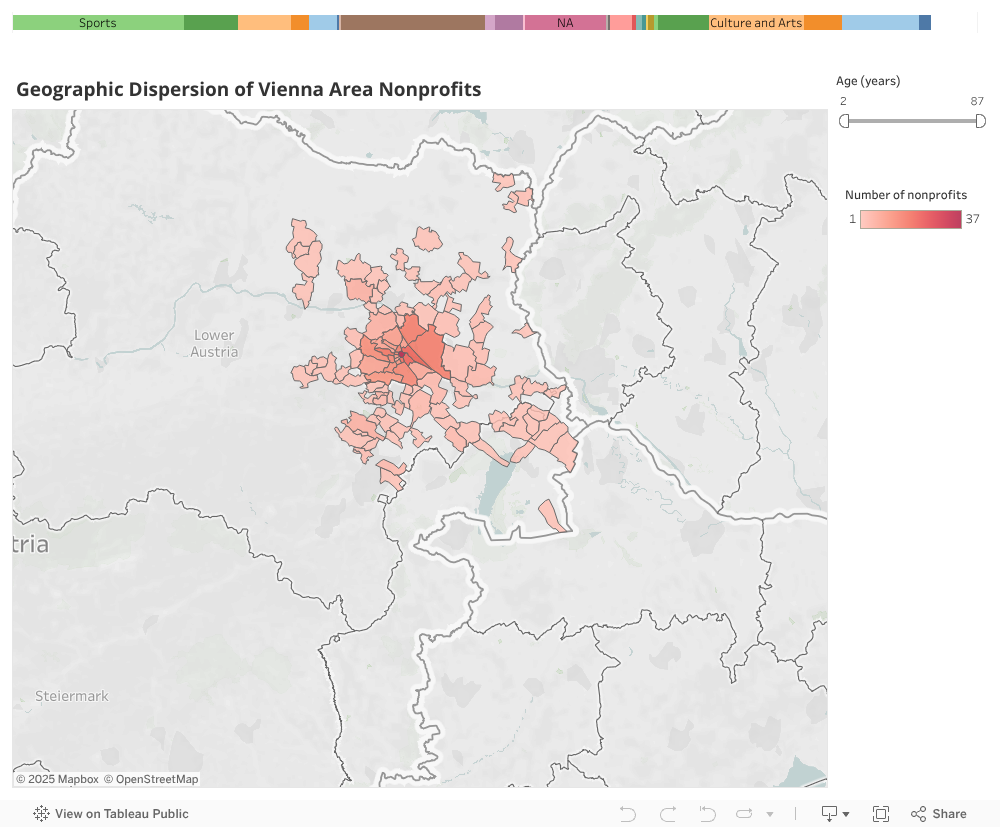
Click on the map to view the interactive dataset in a new tab.
People
- Total residents: 2.5 million
- Race: 61% Austria-born, 39% Foreign-born (31% Europe, 6% Asia, 2% Africa)
- Median household income: €29,000 ($33,000 USD)
- Poverty rate: 6% (at risk of poverty and suffering from severe material deprivation)
Nonprofit Sector
- Total nonprofit organizations: 20,000
- People to nonprofit ratio: 125 people: 1 nonprofit organization
Place
- Area: 2,935 sq. miles (7,600 sq. km)
- Population density: 371 inhabitants/sq. km (Density in urban core: 4,500 inhabitants/sqm)
- Founded: 1146
All indicators are as of 2019.